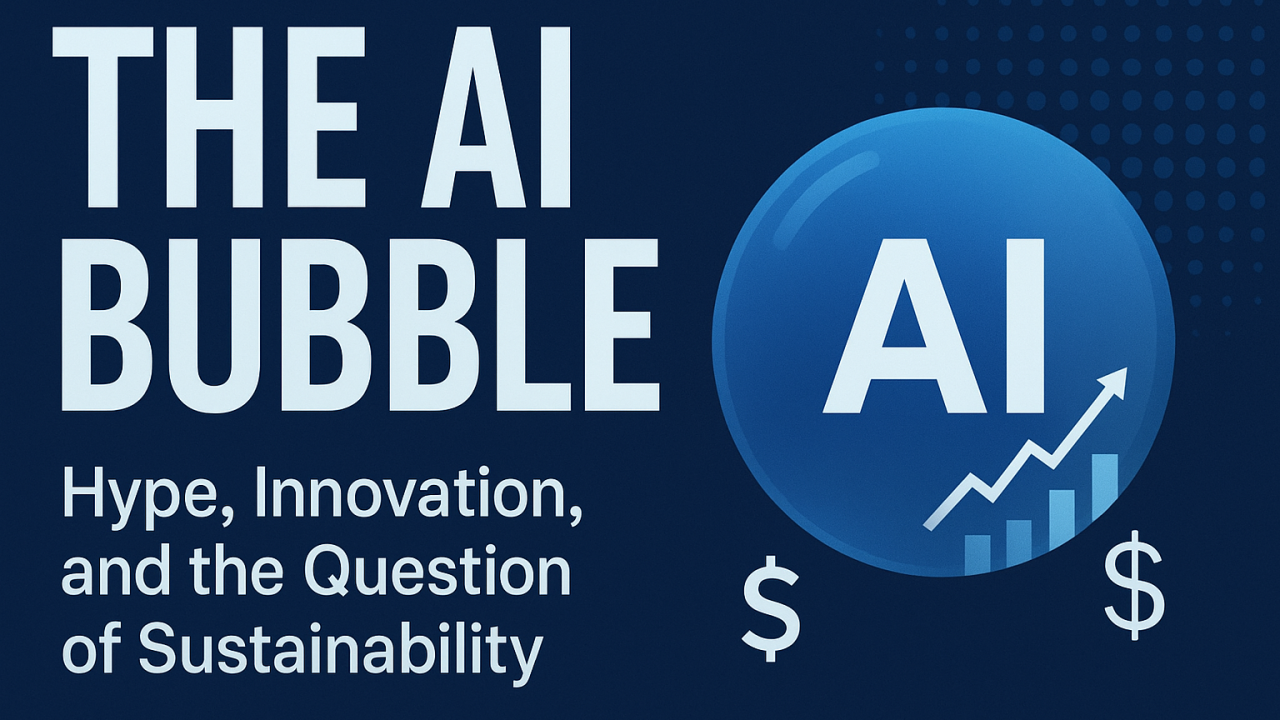
AI Bubble: Is Artificial Intelligence Hype Getting Ahead of Reality?
The phrase “AI bubble” keeps showing up because the market is sending mixed signals. On one side, AI is attracting huge investment and pushing major companies to spend heavily on chips, data centers, and model development. On the other, many businesses still struggle to turn AI experiments into clear profit. That tension is why the bubble debate matters.
A balanced view is this: parts of the AI market look bubbly, but AI itself is not empty hype. The technology is real, adoption is rising, and useful products are being built. The bigger question is whether current valuations and spending are running ahead of business returns.
Why People Think AI Is a Bubble
Bubble concerns usually appear when excitement and expectations rise much faster than proven value. That pattern is visible in AI right now. Stanford’s 2025 AI Index said corporate investment in AI rebounded, the number of newly funded generative AI startups nearly tripled, and business adoption accelerated after years of slower movement. CB Insights also reported that global venture funding in 2025 reached $469 billion, the highest level since 2022, but said the rebound was concentrated mainly around AI leaders rather than the broader startup market.
That concentration is a warning sign. When capital flows heavily to one theme, markets can start rewarding the story more than the fundamentals. Goldman Sachs said in late 2025 that AI bubble concerns had returned amid rising valuations, continued massive AI spending, and increasing circularity in the AI ecosystem. In simple terms, money is moving through the AI stack while investors assume the whole chain will eventually justify the cost.
Why The AI Story Is More Than Hype
Still, calling the whole sector a bubble misses an important fact: AI is already being used at scale. McKinsey’s 2025 global survey found that 78 percent of respondents said their organizations use AI in at least one business function, up from 72 percent in early 2024 and 55 percent a year earlier. It also found that 71 percent regularly use generative AI in at least one function. Those are not tiny pilot numbers.
The same survey showed why optimism remains high. Companies are seeing revenue increases and cost reductions inside certain business units using generative AI, especially in marketing, sales, service operations, software engineering, and IT. So the technology is producing real value in specific workflows, even if the gains are uneven and still early.
Where The Bubble Argument Gets Stronger
The strongest case for the AI bubble thesis is not that AI is fake. It is that expectations may be ahead of realized returns. McKinsey found that more than 80 percent of respondents said their organizations were not yet seeing a tangible enterprise-level EBIT impact from generative AI, even though use was spreading quickly. That gap between adoption and broad financial payoff is where investor nerves start to show.
This explains why the market feels split. AI is useful, but usefulness does not automatically justify every valuation, startup raise, or infrastructure buildout. A company may save time with AI tools without generating enough durable profit to support extremely high expectations. That does not mean the technology fails. It means markets may be pricing in future success long before that success is visible in earnings.
What Businesses Should Focus On
For business owners and marketers, the best response is not to panic about an AI crash or blindly chase every new tool. The smarter approach is to focus on practical return on investment. McKinsey notes that workflow redesign and strong AI governance are among the factors most associated with higher value capture. That means winning companies are not just buying AI software. They are changing processes, assigning leadership, and measuring outcomes carefully.
It is also worth following grounded research instead of social media excitement. Useful starting points include the Stanford AI Index, McKinsey’s State of AI, Goldman Sachs’ analysis on AI bubble concerns, and CB Insights’ venture funding reports.
Final Thoughts
So, is there an AI bubble? The honest answer is partly yes and partly no. Yes, because some valuations, funding patterns, and expectations appear overheated. No, because AI adoption is real, spending is tied to a technology with genuine utility, and businesses are already finding value in specific use cases. The biggest risk is not that AI disappears. It is that the market expects a straight line from hype to profit, when real technology adoption rarely works that way.
The companies most likely to win will be the ones that treat AI as a tool for disciplined transformation rather than a magic story for quick attention. That is usually how bubbles get separated from lasting platforms: first comes excitement, then disappointment, and finally the real winners prove where the value actually lives.