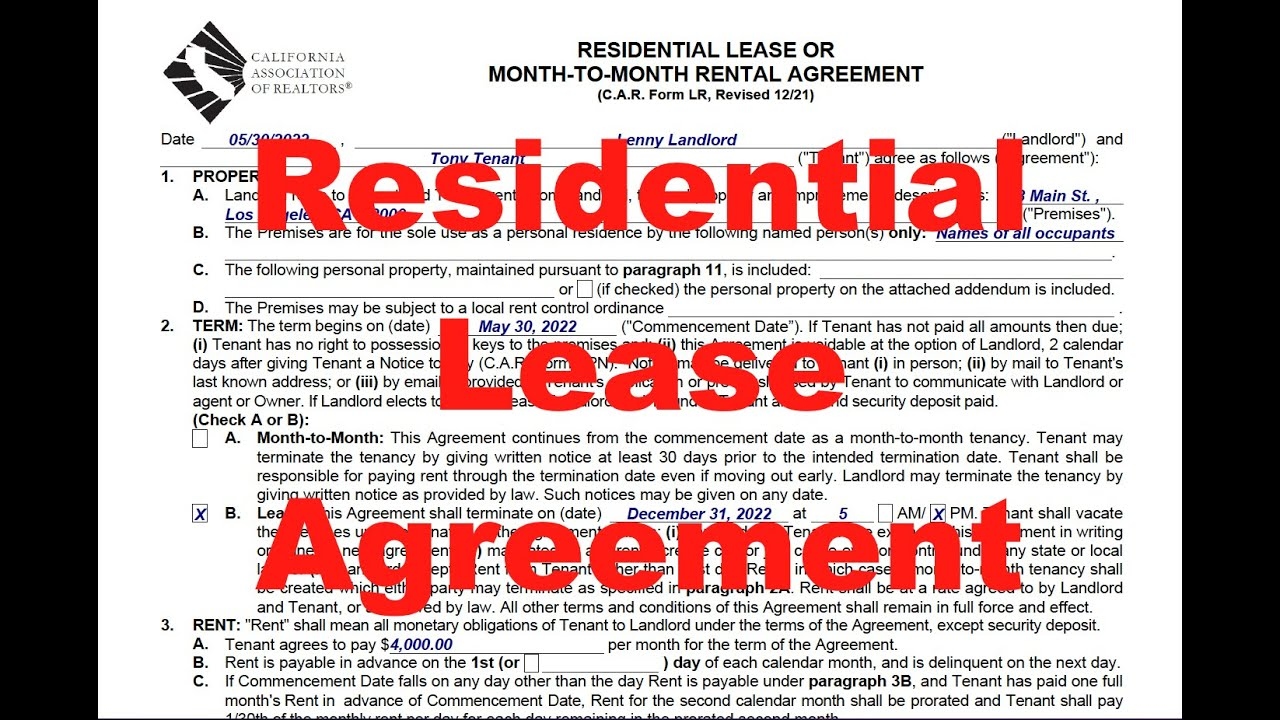
California Association of Realtors Residential Lease Agreement Form: What It Is and What to Know
If you are searching for the California Association of Realtors residential lease agreement form, you are usually looking for the standard C.A.R. lease document commonly used by California real estate professionals for long-term residential rentals. On C.A.R.’s official standard forms list, the form is identified as RLMM, which stands for Residential Lease or Month-to-Month Rental Agreement, and the current revision shown on that list is 2024-12. C.A.R. itself describes the organization as a statewide trade association focused on professionalism in real estate.
What the C.A.R. Residential Lease Form Is
The C.A.R. residential lease form is designed to create a written rental agreement between a landlord and a tenant for a California residential property. One important detail is that the title itself covers both a fixed-term lease and a month-to-month arrangement, which makes it flexible for many common rental situations. Because it is part of the official C.A.R. standard forms library, it is widely recognized in the California real estate industry and commonly used by REALTORS®, brokers, and property managers who work within the C.A.R. system.
How People Usually Access the Form
In practice, most people do not get this form as a simple free public download. C.A.R. routes users through its forms systems and member tools, and its leasing resource center also states that users can access the C.A.R. Application to Rent and Lease Agreement directly through RentSpree. That is a strong sign that the form is typically distributed through professional channels rather than as an unrestricted public template. C.A.R. materials also show that its forms are treated as copyrighted documents, which is another reason people usually obtain them through authorized platforms instead of random third-party websites.
Why This Form Matters in California
California rental law is detailed, and a professionally maintained lease form can help organize the basic business terms of the tenancy in one place. That said, the form itself does not replace California law. The Attorney General’s tenant guidance makes clear that statewide rules still apply, including limits on certain rent increases, required written notices for rent hikes, and the rule that a tenant can only be evicted through a court process rather than by lockout or utility shutoff. In other words, even a well-known lease form works together with California landlord-tenant law, not above it.
Key Legal Issues That Still Need Attention
Anyone using a California residential lease should pay close attention to the legal rules that sit behind the form. For example, the California Department of Justice says rent can generally be increased by no more than 10% in one year, and in some locations the cap may be lower because of local law. The same DOJ guide says landlords must give formal written notice at least 30 days before a rent increase takes effect, or 90 days if the increase is more than 10%. It also stresses that a landlord cannot legally remove a tenant without a court order. These are the kinds of rules that make careful review of any lease agreement especially important in California.
Security deposits are another major issue. The California DOJ’s security-deposit guide says that, after July 1, 2024, the general limit is one month’s rent, with a narrower exception allowing up to two months’ rent for certain small landlords who meet specific ownership conditions. The guide also explains that deposits are refundable and can only be used for certain allowed categories, such as unpaid rent, certain damage beyond ordinary wear and tear, cleaning to restore the unit to its original level of cleanliness, and in some cases restoring personal property if the rental agreement allows it.
Another commonly misunderstood area is landlord entry. California Civil Code section 1954, as reflected in the state legislative text, says a landlord may enter only in specified situations, such as emergencies, repairs, agreed services, showings, abandonment, or court order. The same text says reasonable written notice is generally required, and 24 hours is presumed reasonable in the absence of evidence to the contrary. That means a lease should be read with these statutory limits in mind, because access rights are controlled by law as well as contract wording.
Who Should Use It Carefully
For landlords, agents, and tenants, the biggest mistake is assuming that a standard form is automatically complete for every situation. California rentals often involve additional disclosures, local rent rules, property-specific addenda, flood hazard disclosures, or management terms that may need to be added depending on the property and the city. C.A.R.’s own resources show that the organization maintains a broad set of leasing and property-management materials, which suggests that the lease form is often only one part of a larger compliance package.
Final Thoughts
The California Association of Realtors residential lease agreement form is best understood as the C.A.R. RLMM Residential Lease or Month-to-Month Rental Agreement, currently listed by C.A.R. as revision 2024-12. It is a recognized professional form used in California leasing, but it should never be treated as a substitute for the state’s landlord-tenant laws or for local legal requirements. If you are actually preparing to sign or issue one, the safest approach is to use an authorized source and make sure the final lease package is reviewed for California compliance, especially on deposits, notices, disclosures, entry rights, and local rent rules.