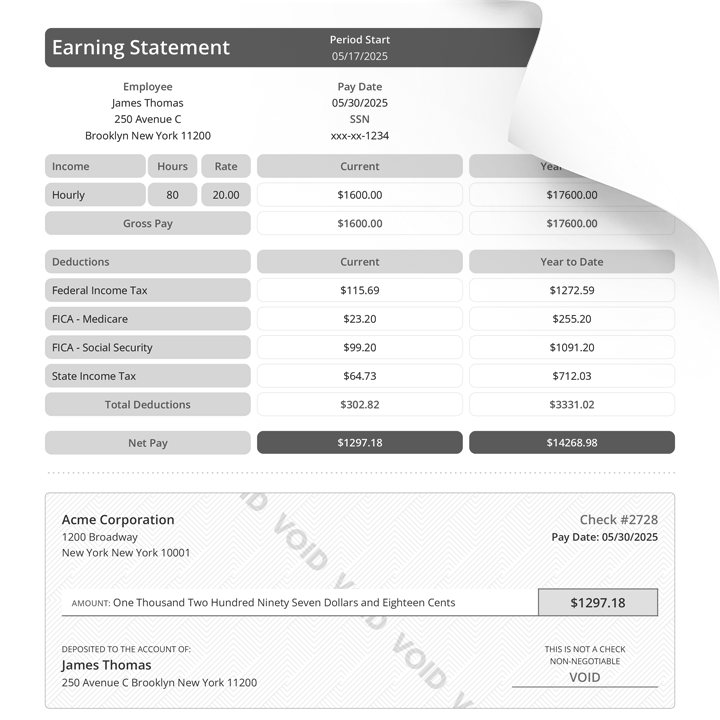
California Paystub Generator: What It Should Include and Why Compliance Matters
A California paystub generator can be a useful tool for employers, payroll teams, and small business owners who need to create accurate wage statements for employees. In California, a pay stub is not just a helpful record. It is a legal document that must contain specific information every time wages are paid. That means a good generator should do more than calculate earnings. It should help produce wage statements that match California’s itemized-statement rules and support proper payroll recordkeeping.
What a California Paystub Generator Does
At its core, a California paystub generator is a payroll tool that creates an employee wage statement showing earnings, deductions, hours, rates, and net pay for a specific pay period. In California, employers must furnish an accurate itemized statement semimonthly or at the time wages are paid, whether the wages are paid by check, cash, or another method. California also generally requires wages to be paid at least twice during each calendar month, with some exceptions.
Because of that, a legitimate California paystub generator should be built for real payroll use and legal compliance. It should never be used to fabricate income or create misleading employment records. The safest and smartest use is for lawful payroll processing, employee documentation, and internal recordkeeping. That approach protects both employers and workers.
What California Requires on a Pay Stub
California Labor Code section 226 lays out the core information that must appear on a wage statement. According to the statute and the California Labor Commissioner’s guidance, a compliant pay stub must show gross wages earned, total hours worked for nonexempt employees, piece-rate information when applicable, all deductions, net wages earned, inclusive pay-period dates, the employee’s name and last four digits of the Social Security number or another employee ID number, the employer’s legal name and address, and all applicable hourly rates with the corresponding hours worked at each rate.
That list is exactly why California businesses should be careful when choosing a generator. A basic generic stub maker may not be enough if it leaves out multiple hourly rates, piece-rate details, or proper employer identification. If a business has overtime, blended rates, shift differentials, or different job roles in one pay period, the generator should be able to reflect that clearly on the wage statement. That is an inference from the legal requirements, but it is a practical one.
Why California Payroll Compliance Is a Big Deal
California treats wage statements seriously. Under Labor Code section 226, an employee who suffers injury because of a knowing and intentional failure to comply may recover the greater of actual damages or statutory penalties starting at $50 for the initial pay period and $100 for each subsequent pay period, up to an aggregate of $4,000, along with costs and reasonable attorney’s fees. The same section also gives employees the right to inspect or receive copies of payroll records, and employers must comply as soon as practicable, but no later than 21 calendar days after a written or oral request.
The statute also says employers must keep a copy of the statement and deduction record on file for at least three years in California. That means a strong paystub generator should not only create a stub but also help store or export records in a way that supports retrieval later. If a system cannot archive statements cleanly, it may create headaches during audits, employee requests, disputes, or final-pay issues.
Features to Look for in a Legitimate California Paystub Generator
The best California paystub generators are the ones that support compliance by design. That means they should allow accurate pay-period dates, employer legal entity details, employee identifying information, multiple pay rates, deductions, and correct net-pay calculations. California’s Labor Commissioner also provides sample pay stub formats for hourly and piece-rate workers, which gives employers a useful benchmark for what a compliant statement should look like.
It also helps if the tool works alongside broader payroll systems. The California Employment Development Department says the state has four payroll taxes, with Unemployment Insurance and Employment Training Tax paid by employers, and State Disability Insurance and Personal Income Tax withheld from employee wages. EDD also directs employers to e-Services for Business to manage payroll tax accounts, filings, and payments. In practice, that means many businesses benefit from a generator that fits into a real payroll workflow instead of operating as a standalone document maker.
Who Can Benefit From Using One
A California paystub generator can be especially helpful for small businesses, household employers, startups, and growing companies that need cleaner payroll documentation. It can also help companies that want to reduce manual mistakes when calculating hours, deductions, and wage rates. For employees, accurate pay stubs matter too, because the Labor Commissioner encourages workers to keep every pay stub and use those records if questions arise about wages, deductions, or accrued benefits.
Still, the tool is only as good as the data entered into it. If hours are wrong, rates are outdated, or deductions are entered incorrectly, the finished pay stub can still be noncompliant. A generator helps with formatting and structure, but it does not replace correct payroll setup or legal review.
Final Thoughts
A California paystub generator should be viewed as a compliance tool, not just a convenience tool. The right one helps employers issue accurate itemized wage statements, keep records, respond to employee requests, and support a cleaner payroll process under California law. Since California requires specific information on every wage statement and attaches penalties to knowing and intentional failures, choosing a generator that is built around real payroll compliance is the smartest move.